Embedded Supply Chain Finance
- When Credit Becomes Part of Commerce Not a Separate Process
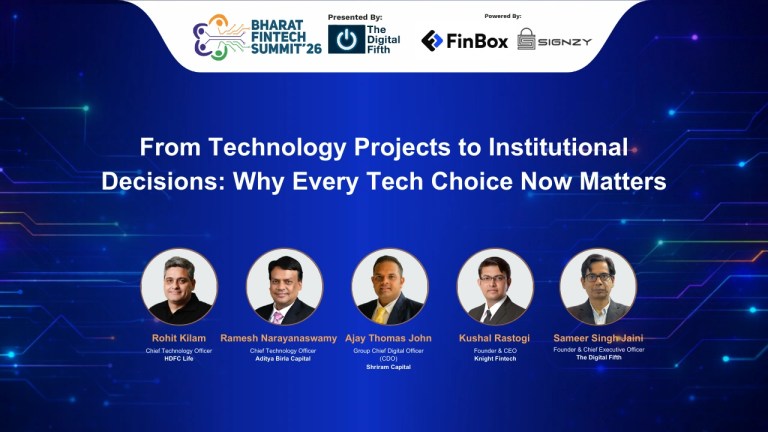
At the recent summit, Sriram Kanuri, Parag Jain, and Sameer Singh Jaini unpacked a structural shift that could redefine MSME lending in India: Embedded Supply Chain Finance (ESCF).
The premise is simple and powerful.
For decades, banking and commerce have operated on parallel tracks. A distributor buys goods. Then separately applies for credit. A retailer generates invoices. Then uploads them to a bank portal. Credit approval happens after the transaction has already created stress.
Embedded finance asks a fundamental question: What if credit is triggered inside the transaction itself?
- The MSME Credit Gap Isn’t About Intent It’s About Architecture
India’s MSMEs are economically vibrant but financially constrained. Working capital remains expensive, underwriting is documentation-heavy, and risk assessment is largely backward-looking.
Most lending decisions still rely on:
- Bureau data
- Bank statements
- Historical financials
But the real story of a business unfolds elsewhere inside its ERP system.
Purchase orders, invoice cycles, inventory turnover, repayment behavior these are live signals. They show intent, velocity, and operational health in real time.
Traditional underwriting looks at what happened.
Embedded finance evaluates what is happening.
That shift changes everything.
- From “Apply for Credit” to “Activate Credit”
In the traditional supply chain finance model, friction is everywhere. A distributor downloads an invoice, uploads it to a bank portal, waits for approval, and often receives funds when the opportunity window has already passed.
In an embedded model, the credit option appears at the point of purchase much like choosing EMI at checkout in e-commerce.
Instead of:
- Manual uploads
- Delayed approvals
- Post-event underwriting
You get:
- Contextual credit triggers
- Pre-approved limits
- Auto-reconciliation within ERP
- Real-time settlement
Credit becomes invisible infrastructure integrated, not requested.
- Why ERP Data Is a Game-Changer?
One of the strongest insights from the discussion was this:
Statements are static.
Bureaus are lagging indicators.
ERP data is behavioral intelligence.
Every event inside ERP creates a financial signal:
- A purchase order signals upcoming liquidity need
- Sales velocity signals repayment capacity
- Inventory cycles signal working capital stress
When lenders tap into these signals, risk management becomes proactive instead of reactive. Instead of detecting defaults late, the system can recalibrate exposure early.
- Lower Cost, Lower Risk Higher Precision
Embedded SCF also changes unit economics.
Traditional MSME lending can involve high acquisition and underwriting costs. Field visits, documentation checks, and manual validation add friction and expense.
By contrast, embedded models leverage:
- Digital onboarding
- API integrations
- Automated reconciliation
- Usage-linked credit flows
Because funds are tied directly to commerce activity, misuse risk reduces. Because exposure is contextual, underwriting precision improves.
It is not just faster credit, It is structurally smarter.
- Beyond Invoice Discounting
Embedded supply chain finance is often misunderstood as just invoice discounting 2.0. It’s much broader.
It impacts:
- PO financing
- Distributor and dealer funding
- Factoring models
- Anchor-led ecosystem financing
Platforms like TReDS have already formalized invoice discounting at scale. Embedded SCF goes deeper integrating credit directly within operational systems instead of treating invoices as standalone financing assets.
This is the difference between marketplace finance and infrastructure finance.
- What Will Determine Success?
Technology alone will not scale embedded finance. Ecosystem alignment will.
For this model to mature, five forces must work together:
- Anchors willing to open ERP access
- Banks ready with API-enabled infrastructure
- Clear regulatory comfort
- Fair economic incentive sharing
- Strong risk monitoring frameworks
India’s digital public infrastructure gives it a head start. But coordination between commerce players and capital providers will define the pace.
- The Bigger Shift
Embedded Supply Chain Finance is not a feature addition to lending. It is a philosophical shift:
From financing businesses → to financing transactions.
From static underwriting → to live monitoring.
From credit as a product → to credit as infrastructure.
If scaled correctly, this model can reduce MSME cost of capital, improve supply chain reliability, and structurally lower default risk.
More importantly, it aligns commerce and capital in real time.
And when that happens, credit stops being a bottleneck.
It becomes an engine built directly into the supply chain itself.