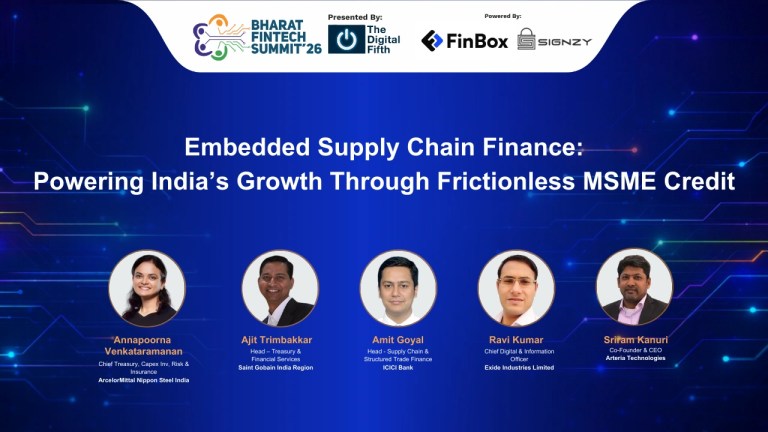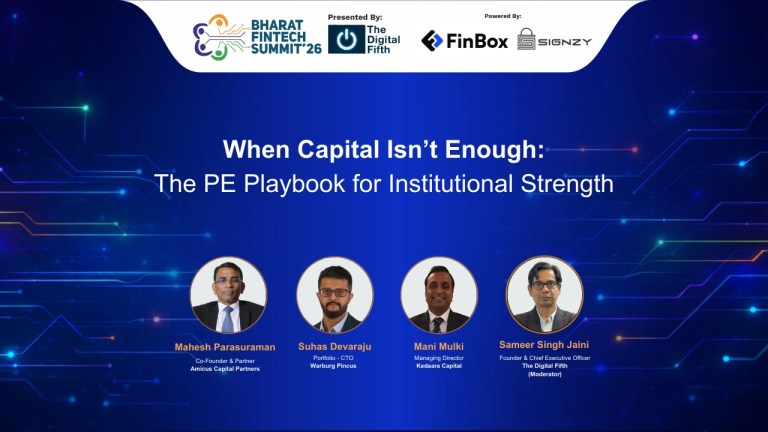
MSME Value Chain & Smarter Lending
- Rethinking Credit Through Ecosystem Intelligence
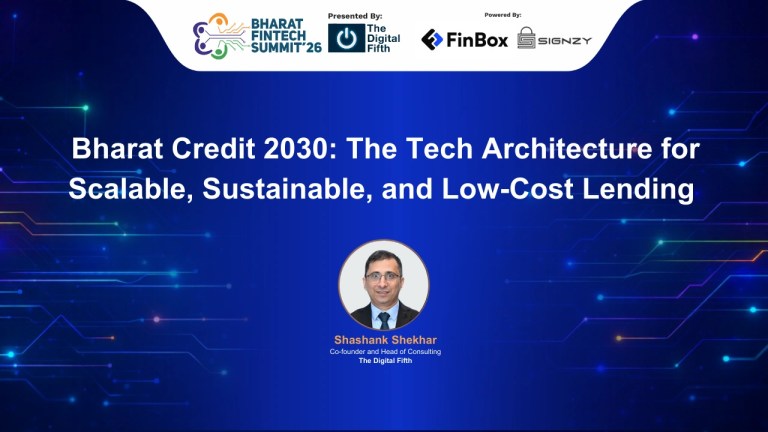
At Bharat Fintech Summit, Shashank Shekhar delivered a powerful message that challenges the traditional approach to MSME financing:
MSMEs should not be assessed in isolation. They must be understood within the value chain they operate in.
As India’s lending ecosystem evolves, this shift in perspective could redefine how banks, NBFCs, and fintechs unlock the next phase of MSME growth.
- The MSME Opportunity and the Credit Gap
India has over 7 crore MSMEs, with nearly 4 crore classified as micro enterprises. They operate across manufacturing, trade, services, agriculture, healthcare, textiles, electronics, and education.
Yet, despite their scale and economic contribution:
- A large percentage still depend on informal sources of credit
- Working capital gaps remain significant
- Formal underwriting often fails to capture their true business potential
The issue is not just lack of capital, it is lack of contextual understanding.
Traditional credit models rely heavily on:
- Financial statements
- Bank statements
- Collateral
- Static financial ratios
But MSMEs don’t operate like large corporations. Their financial behavior is deeply tied to industry cycles, seasonality, anchor relationships, and supply chain dynamics.
- Why MSMEs Cannot Be Viewed in Isolation
An MSME is rarely a standalone entity. It is a link in a larger economic chain:
Supplier → Manufacturer → Distributor → Retailer → Consumer
Credit disruption at any point impacts the entire chain.
Consider a food processing MSME:
- Raw materials are procured seasonally
- Production may span several months
- Sales realization may happen much later
This creates a long working capital cycle. If lenders assess only static cash flows, they misjudge both risk and potential.
Understanding the value chain answers critical questions:
- Who are the anchors?
- What is the payment cycle?
- Where does cash get blocked?
What is the industry-specific margin structure?
Industry-Specific Realities Matter
Not all MSMEs behave the same way.
Agriculture & Food Processing
Strong seasonality. Long inventory cycles. Cash inflow concentrated in specific months.
Textile & Apparel
Extended manufacturing cycles. 90–120 day receivable periods. Demand linked to seasonal trends.
Electronics
High-value inventory. Rapid model obsolescence. Fast turnover required to avoid losses.
Healthcare
High operational costs. Equipment-heavy operations. Continuous service expenditure.
Training & Education
Enrollment-based revenue. Installment collections. Seasonal peaks around admission cycles.
A 6–8% margin in pharmaceuticals may be healthy.
The same margin in a services business could signal weakness.
Segment intelligence is non-negotiable.
- The Three Pillars of Smarter MSME Lending
Shashank outlined a framework built on three core lenses:
1. Visibility
Understand the MSME’s ecosystem:
- Anchor relationships
- Purchase order patterns
- Historical business continuity
If a manufacturer consistently supplies to a strong anchor, risk perception changes significantly.
2. Validation
Go beyond bank statements.
Leverage alternate and digital data such as:
- GST filings
- E-invoicing records
- POS transactions
- Payment gateway settlements
- Utility bill consumption
- ERP system data
- Salary payment patterns
When multiple signals align, underwriting becomes more robust and less assumption-driven.
3. Predictability
Past value-chain participation creates forward visibility.
If an MSME has:
- Stable order flows
- Consistent GST-reported revenues
- Industry-aligned inventory patterns
Then future cash flow becomes more predictable even if traditional balance sheets appear thin.
- From Static Products to Dynamic Structuring
The product itself cash credit, overdraft, term loan may not need reinvention.
But the structuring must evolve.
Smarter lending models can include:
- Input financing aligned to procurement cycles
- Production-stage working capital support
- Invoice-backed financing
- Anchor-led supply chain programs
- Collection-at-source models through POS or gateways
- ERP-integrated credit monitoring
This is not just about lending faster. It is about lending intelligently.
- The Role of Banks, NBFCs & Fintechs
Regulated entities are uniquely positioned to drive this transformation.
By combining:
- Segment-specific underwriting frameworks
- Value chain mapping
- Digital integrations
- Alternate data analytics
Lenders can reduce risk while expanding access. The shift required is philosophical as much as technological.
Instead of asking:
“Does this MSME have enough collateral?”
We must ask:
“How strong is the ecosystem this MSME participates in?
- The Road Ahead
India’s MSME sector is too large and too critical to be evaluated using uniform templates.
The future of MSME credit lies in:
- Ecosystem-based underwriting
- Sector-driven intelligence
- Embedded digital data flows
- Value chain financing
As highlighted at Bharat Fintech Summit 2026, smarter lending is not about increasing exposure.
It is about increasing understanding. Because when lenders understand the value chain, credit stops being a constraint – and starts becoming an accelerator.